Thursday, August 4, 2011

On Board the Tackle


The most common question for the crew of the icebreaker Tackle?  “So what do you guys do in the summer?”  The answer, given many times by each of the crewmembers aboard; “We tend Aids to Navigation, specifically day and range markers.”  One crewman added a second sentence, “We do a lot of training in the summer, that’s when the new members come on board.”  And apparently, though they were too professional to mention it, they also attend various festivals and deal patiently with visitors.
Everything from Rockland must display a lobster
We’d come to the Bucksport Bay Festival for entertainment, knowing the Navy Frigate USS John L. Hall would be there, but little else.  We were totally delighted to discover the Tackle at the dock.  The Tackle and the Bridle are two icebreakers tasked with clearing the Penobscot River and Kennebec.  Chief Deery noted that they keep the Penobscot clear all winter, but clear the Kennebec only in the spring.
Unfortunately we arrived at the docks at exactly the wrong time, just as the steamer, Patience, was headed out on a tour, the Tackle was planning to change positions on the dock, and the crew planned a break for lunch. 
The Patience sails away, and the Coast Guard prepares to move
So we returned to the waterfront park.  At first we hiked up to where the naval ship was docked, but the line there stretched back quite a way into the hot sun.  We had no choice but to return to the vendor tents and spend the hour selecting fine treats.  There was a huge collection to choose from, pies of all flavors, BBQ chicken, fried dough, smoothies.  I eventually selected Kettle corn and water, while Mark ordered a hamburger.  We sat in the shade of a small tree and watched as the Patience went first up the Penobscot then down, touring along the edge of Fort Knox.  Meanwhile a fine sailed vessel came up through the narrows.  As it sailed above the bridges, we recognized it as the Bowdoin.
The Bowdoin has one sail up in the top picture, it got the sails down pretty quickly after passing under the bridges
Bowdoin is a training vessel of Maine Maritime Academy(MMA) that we commonly see berthed at its dock in Castine, and too rarely sailing.  This Grand Banks schooner was built in 1921 by Donald McMillian.  In June 2008 it returned to Greenland once again, this time with a training crew from MMA. (More about Bowdoin) Soon the Bowdoin was docked beside the Tackle and open for deck tours.  The prisms for letting light below deck were rectangular, just about 8 inches long.  It doesn't seem like it would be very much light.
Bowdoin can sleep a crew of 15 and seemed to have at least that many aboard for this trip (though I didn’t do a count.)
Wandering the Bowdoin was fine, but we really wanted to get aboard Tackle.  The day we bought our house, on the pre-purchase inspection, we arrived just in time to see the Tackle bravely working its way up the icy river.  It’s a rare treat to see the vessel plying our waters, both because I spend many hours at work in the winter and also because we do very little paddling once the waters have iced over.  Mark mentioned to Chief Deery that the controls for the Tackle were just like tug controls and recently, while visiting Mystic Seaport, he’d “piloted” a simulated tug, with full sized controls.  Despite this sterling credential, Mark wasn’t allowed to take the craft out. 

But we could put our hands on the artfully decorated wheel.   And in return we’ll pass along this request:  label your kayak with a name, address and phone number, so if it’s found the Coast Guard can easily determine if a search is necessary.
Winter on the Penobscot

Monday, August 1, 2011

Bangor has a new Paddle Craft Dock


Summary:  High 10:15AM;  launch 9AM, finish noon, 9.8 miles.  About a mile to paddle the lower canals of the Kenduskeag, about 2 miles to the waterworks, about 4.5 miles to fast water.  The water below the Bangor waterworks is featured in my Caution photos. Some high tides make travel under the bridges on the Kenduskeag impossible.  With the Waterfront concert series array of dozens of portapotties seems to be in place.  Dragging your boat down the ramp, or sliding it on the railing will result in scratches!
 

We were walking on the Bangor waterfront when we spotted this new dock.  Well, maybe not entirely new, Bangor used to put a Paddle Craft dock in below the Joshua Chamberlain bridge, right at the mouth of the Kenduskeag.  But this is in a new location at the southernmost end of the docks.  There was a fisherman using the dock. Which is a good thing, the more regularly the dock is used the less likely it is to follow in the footsteps of the Bucksport Paddle Ramp and become a seagull hangout.

So we decided to test the dock out.  With a long gangplank, and a fairly long carry over sidewalks, access to this launch is aided by a cart, or a helpful companion.  The closest parking is tucked behind the Waterfront Concert Stage, and so long as there are no events at the Waterfront, is usually empty.  (It is also one of the first parking lots to be closed if there is an event scheduled.)  Access to the sidewalk is aided by a convenient handicapped curb-break right at the end.  Getting a long kayak angled for the ramp takes some doing, I found it easiest to put the front down and lift from the back. 
The dock has a special lower dock to the side, making it easy to get into a kayak using the paddle brace.  The key is to start from a sitting position on the dock.  The boat hand anchors the paddle to the boat, one foot slides in first, then the butt makes a quick move into the seat.
It had been a beautiful day when we’d spotted the dock, but it was a gray humid morning when we took off on the river.  We were headed north, up to the waterworks.  We started out an hour before high, and I was a little surprised by the strength of the upstream current.  We paused at the Getchell Brothers Ice Factory to watch the Archimedes screws move waste ice along a rather complicated set of ramps.  Below, a ground hog watched us nervously. 
We made good time heading up to the Waterworks.  I once had a kayak advertisement which talked of being “helped along by a gentle breeze.”  It made me smile, because if you can feel the wind helping you, you should know it will have twice the deterrent when you decide to head back.  The advertisement also mentioned how happy this paddler was to have left an annoying cellphone on the kitchen table.  Let’s hope the paddler didn’t have cause to regret that oversight!
Anyway, I did turn around to check out the situation, the wind was present, but not excessive.  And we’d made such good time, we figured why not continue up to the fast water at the bend below the Veazie Dam. 
Just above the Waterworks are the remains of an older dam built in 1875 and removed in 1995. At high tide, in the summer, it’s easy to paddle over this section. 
The old waterworks building, which was once featured in Stephen King’s Graveyard Shift is now low-income housing, made available by a joint effort of the Shaw House and other private and Government agencies. 
The water that flows by their homes changes texture significantly through the tide cycle (See Caution).  I’m not entirely cognizant of how the flow changes with the tide, so I’ve usually stayed with crossing over the dam within an hour of high.  There are also seasonal changes: in the spring or after significant rain) not many people could paddle up beyond the waterworks.
It was an hour before high when we crossed over the dam remnants, so I figured we were safe paddling north until high.  Bud Simpson, in Mantawassuk: The Cove talks about growing up back when this stretch of the Penobscot was dammed.  He shares some interesting tales, about the joys of exploring wild areas in your neighborhoods.  His tales are made all the more poignant because the cove is gone permanently.  His book includes photos of this prominent rock back in his days.
Coming up on a power plant, I'm on the Brewer side, but I'll cross over soon
We hoped to get high enough to see the Veazie dam, but we had no luck doing that from the Veazie side.  Eventually the water is so shallow and fast that paddling upstream became an exercise in slamming  blades against rocks.
That's as far as I got!
So we turned around, faced the wind and began our journey downstream. We went back over the dam about an hour after high, the river was at about the same height it had been on the journey upstream.
Pretty yellow flowers on the shore; and some purple loosestrife
On our way back to the dock we decided to duck in and see Bangor’s canals. 
Warren Manning, a Boston landscaper, built the Norembega Mall after the Great Bangor Fire in 1911, removing dilapidated buildings and cribwork, and replacing them with canals reminiscent of Venice.
A pigeon, or city guillemot

Getting out onto the dock, is just like getting in, only in reverse, don’t aim to get your feet on the dock, aim to get your butt there.  And it’s best if you line up your boat in the direction you want to pull it up the ramp, since it can be hard to turn your boat around, especially if others are on the dock.  The gangplank had wooden strips across it, terrific for sure footing, but troublesome to a set of low kayak cart wheels.  Don't drag your boat up the ramp; too many screws stick up and will ruin it.
Mark's right hand hold the paddle to the boat, his left keeps the paddle in position on the dock
He psuhes up with his arms and slides out.
I looked without success for a Youtube video which clearly described launching from a dock, especially for the more common situation where a dock is 8-12” above the kayak.  This video is the technique we’ve used on higher docks, though it’s demonstrated from a low dock, but that’s why the paddle isn’t used as a part of the bracing system.  Unfortunately, it does have an ad at the beginning. And it shows a sit on top; with a sit inside kayak it may be easier to put just one foot partially in to start.
I also found this video which is far more intriguing, as it advocates stepping into your boat.  Mark thinks it might be useful for very high docks, and you must admit the guy is quite proficient. Still I suspect a high failure rate, so I think I’ll let Mark try it first. 

Thursday, July 28, 2011

Porcupine Islands Again

Basics: Launch Bar at the end of Bridge Street in Bar Harbor. No parking: parking is available on West Street and side streets. No facilities: the information booth on Thompson Island has toilets, as does the town dock.  High 8.22AM Launch 9:00AM Finish 1:30 PM, 12 miles.

The Porcupines again?  Why not, not only are the Porcupines only an hour away, but I think the Porcupine Islands are one of the best sea kayak trips Maine has to offer.  They have dramatic cliffs, water which feels like open ocean instead of a pond, salt air smell and most important, a backdrop of mountains, lobster boats and sailboats.  And, as is probably no coincidence, Bar Harbor offers many guided kayak tours out to the Porcupines.  Most of the group trips won’t make it out as far as Long Porcupine, much less Ironbound, but there are plenty of great sites on the inner islands as well.

We arrived at 8:30AM, just after high tide.  We headed down Bridge Street, which leads to the bar which gives Bar Harbor its name, a sand and gravel bar between Mount Desert Island and Bar Island.  A new lime green sign cautioned us that parking is not allowed on the bar.  Any temptation to park on the bar was negligible at that hour, as Bridge Street dead ended right into Frenchman’s Bay, with barely room to turn a car around.  We offloaded our kayaks and lined them up tightly against a stone wall.  Then Mark headed off to find one of the few street parking spaces left.  (Morning whale watches leave at 8:30 so the streets fill quickly.) 
Backing down, as Mark drove up, was a trailer full of tandems headed out on tour.
The bar at high, this couple awaits their tour, Mark's boat peaks out by their feet.
Much of the area between Bar Island and Mount Desert Island (MDI- the island with Bar Harbor and other towns on it) drains out by low tide, we took advantage of the high tide to cross over that land, passing by a different set of tandems, this nicely grouped set one which had probably launched from the Town Docks. 
Guillemots were in abundance near the cliffs, the spring weather must have been favorable for them; good for those who enjoy watching dangling red feet taking flight, and bad news for their prey.
Guillemots on rocks

Wind and swells were slight.  The Porcupines are lovely on still days, since we can explore the inlets and keys.  They are impressive in swell, since we can watch waves crash against the high cliffs.
Interesting fracturing on one of the Porcupines
We stopped at the Hop to free what must have been a suicidal attack periwinkle from Mark’s skeg box.  The tombolo between Long Porcupine and the Hop was completely underwater, and the beach pretty small. 
Clear paddling between Long Porcupine and the Hop

We wandered the beach, gathering some drifted trash and taking a few close-ups.  
Water moves over the tombolo
Then it was off to Ironbound.  A few of the inlets seemed tame enough to peek into.  A few cautions to consider should you consider doing the same:  think ahead of time about rescue options should anything go wrong; having a throw rope ready might be a good idea.  Watch the opening through the duration of a few swells to see the pattern inside.  Keep someone outside to watch for passing boats (and their wake) or a change in the wave pattern.  I’ve heard that you should back into caves, since it allows you to keep a good watch on incoming swells, keeps you cautious and makes it easier to get out. 

I never know which, if any, caves will be accessible, some are better at higher tides, others at lower, and they all depend on the direction and amount of sea swell, as well as what other boats are in the area.   A fishing boat filled with a family casting lines puttering surprisingly near the ledge meant one stretch was unavailable.
At the base of a cliff on Long Porcupine
On the way back we stopped at Rum Key for a snack (having promised ourselves Geddy’s Pizza for lunch.)  No surprise, before we left another kayak tour landed for their break. You can see them there in the top photo.  And what a beautiful place for a snack!  
At the channel between Burnt and Sheep Porcupine several harbor porpoise were feeding.  A few surfaced right beside Mark, but were gone by the time a camera was out.
It's easier to get photos of seagulls than porpoises
Coming back to the Bar, especially now that it was fully exposed, was an exercise in contrasts.  We’d been by ourselves at the Hop, seen no other kayaks beyond Rum Key, but on shore we were in the midst of explorers speaking a polyglot of languages.   I think it’s wonderful to see so many people outside enjoying nature, looking at the sea shells, observing the sea gulls, strolling Bar Islands beaches and trails.  Another kayak tour was launching, this one, filled with young children, bounced along like ping pongs, with one tandem continually grounding near the bar.  Strangers passing by took pity on the wanderer, wading into the chilly waters push it to deeper water. 
Cars were parked three rows deep at the end of Bridge Street, parked in what they apparently defined as “not the bar”, though it would be underwater at high.  Threading our SUV down Bridge Street, through the cars, walkers, dogs, motorcycles and bikes was a challenge, and making our way downtown along the narrow streets through the construction area was equally entertaining. (And this on a day without a large cruise ship in the harbor.)  But Geddy's pizza was worth it.
Bar Harbor is justly famous for its amazing vistas and access to nature. Though we spotted several groups, that was over a couple hours and several miles, each group was visually by itself.  These paddlers were lucky to see those incredible islands up close, to watch the guillemots fly from sea to high on the cliffs, to note the eagles soaring above, to spot seals and porpoises, to smell the salt air and paddle through seas of lobster buoys.

Monday, July 25, 2011

Castine - Heat Break

Basics:  Launched from Castine Town Dock, parking limited to 3 hours.  Restroom available. High 5:30AM, Launch 8:30AM finish 11:45AM 8.2 miles.
The smokestack on the Maine Maritime training ship "State of Maine"
Last week: hot, hot, hot, humid and hot, hot, hot. Baffinpaddler posted a good guide to staying cool while kayaking, to which I would add only that mornings tend to be cooler than evenings. Even so, one morning we woke early to paddle on the river, and in preparation I soaked the long sleeves of my rash guard before leaving the house. We walked down the hill and paddled a couple of miles, and in the moist morning air the sleeves were just as wet as when I put the shirt on. There’d been no evaporative cooling at all.
So when Sunday was promised to be cooler, we made plans to go to Castine, counting on an early start to increase the odds it would be cool enough to paddle.
It was a mere 73 degrees when we launched at 8:30AM, and not hard to find a parking space.
The waters were fairly busy though, sailboats and other pleasure boats headed out, this windjammer headed in.
Motoring by Dyce's Head lighthouse
The schooner came from the protected harbor behind Nautlius Island. A number of boats take advantage of those quiet waters to anchor overnight.
I like the way this ledge, near Holbrook, echoes the distant Camden mountains
With a fair wind from the north we paddled by Nautilus, along Holbrook Island  and over to Harborside, before turning back into the wind, paddling between Holbrook and Brooksville, then back along the outside of Holbrook to a favorite beach, filled with rounded rocks.
Finally back through the choppy windswept waters to the town dock, just a short paddle, but a joy to be out in cooler weather.
Seal lovers might be happy to note a number of seals lingering on ledges near Ram Island
Meanwhile the Victory Chimes now had its sails aloft and was headed out for the day. Victory Chimes is a three masted schooner out of Rockland, and if it looks somewhat familiar it’s because it graced the reverse of the Maine State quarter .
Congratulations to Mike, the Durhamblogger for helping out in Louisiana during this hot, hot week!

Friday, July 15, 2011

Beals Island Maine


Basics: Launch Beals Island, Alternative Jonesport. Moderate parking, tough ramp at low tide. Portapottie. Best paddle for mid to late summer, on a Sunday. Launch 9AM, finish 1:30PM low 1:30PM, 11.8 miles

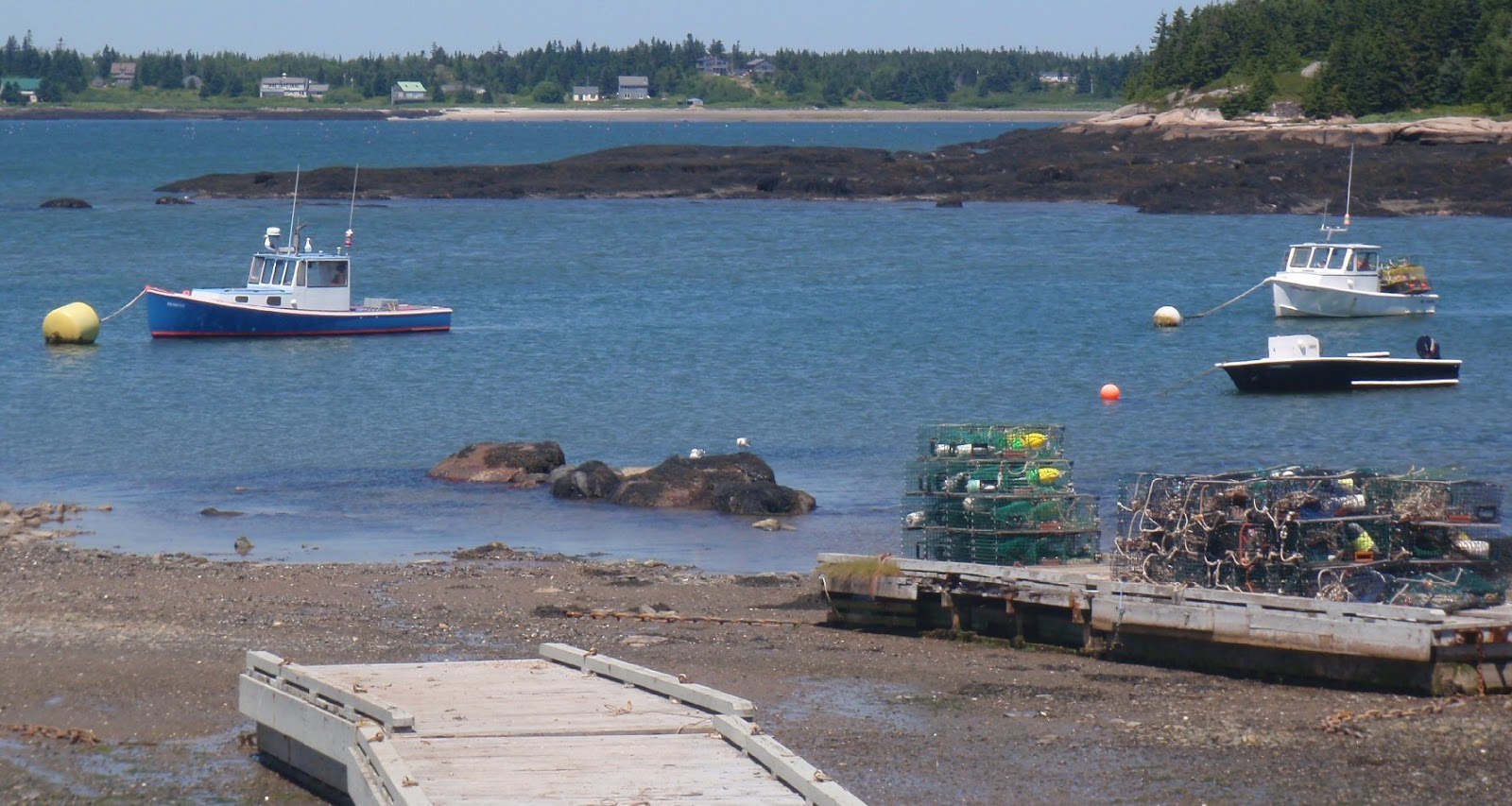
6:30AM on a Sunday and I was up and ready to go. We were headed to Beals island, a site we visited first last winter while checking out their giant Trap Tree. The water off Beals looked so inviting, full of islands and ledges, surrounded by an archipelago that we knew we wanted to head back in the summer to paddle. But it also looked like a serious lobstering community, traps piled high in every yard. The ramp lots were small enough that we didn’t want to interfere with anyone who needed parking. So we planned a trip for Sunday, a day when traditionally little lobstering is done (though there are no rules about not lobstering on Sunday).
We used all of our guide books to help plan our adventure, but especially Kayaking the Maine Coast, by Dorcas Miller, which does a great job of describing island ownership. She also reminded us that fog was a significant risk in the area, something we knew from our past experience of attempting to visit Halifax Island off Roque Bluffs. That took two separate trips up, as the first was too foggy, and filled with boat noises to attempt a crossing.
But this day we were lucky: a bit over two hours after departure we arrived to clear skies and just enough wind to keep things cool. Just before 9AM and we were the only car in the lot, though some trucks were parked by a nearby wharf. It took a few minutes to orient ourselves, it turns out the launch wasn’t where we remembered it being, but a nearby spire in Jonesport helped us find our place (The spire is peeking up in the right above).
From there we were off, crossing the extremely narrow channel to Pig Island and soon we were in Eastern Bay.
Two boats in the Harbor, Pig Island behind
Eastern Bay is filled with seals. Every ledge seemed to have 20-30 seals on it and more could be heard barking on distant ledges. As a result we tended to stay between ledges, rather than sticking close to shore. Fortunately, there were very few boats out.
The blurry blobs at the bottom are seals
We piloted along, double checking against the chart. In a new area with so many ledges and islands this was a good review of navigation skills. We spent a fair amount of time debating which distant blobs of lands had which names. At one point we even had to paddle out to a can buoy to verify our actual position.
Heading for Black Island
On a dropping tide we were able to get between Black Island and Steele Harbor Island and headed out through Head Harbor to the open water. We did this knowing there would be big water and confused currents, an assumption which was reinforced by waves crashing against the sides of the opening.
Head Harbor, crashing surf by Man Island
Sure enough, outside the archipelago we found ourselves in big swells, not huge, but enough that we found ourselves paddling uphill alot. The challenge in getting out in water like this is that paddling into waves, up the front and down the back is easy. It’s going sideways or with a following sea which is more difficult. We’d been through a surf zone once this season, while off Cape Cod, so we felt confident we could paddle through surf, should it develop, and at least make it back the way we’d come. In the meantime, being out in these swells was exhilarating, but also quite humbling; an instant reminder of the difference between day trips in protected areas and any trip in exposed coastal conditions.
As we paddled up and down, a skiff buzzed along outside us, popping in and out of view. Meanwhile a lobster boat headed our way from out by Mistake Island. We watched the boat carefully, knowing we were probably not very visible to the lobsterman, assuming he was even looking and not distracted by some work on his boat. We did what we usually do in these situations, gathered close, moving slowly, but keeping our paddles in full motion (moving paddles are much more visible than stationary ones). As the boat continued on by Main Channel Way, and was still pointed straight for us, I was reminded of the hypothetical situation often given for the Maine Guide exam, where a client goes missing after a boat passes through. In these waters, where breaking waves were keeping us some distance offshore, that would be a disaster indeed. But fortunately, there weren’t six large tandems in our group, just the two of us, in nimble single person kayaks, so it was an easy process to move out of his way, further off shore. He waved as he went by, and we waved back before continuing southwest.
We lucked out too, in that Main Channel Way was quite calm. There were confused waters toward the outside, a result of waves echoing between the rocky shores, but no breaking water, and soon we were back on the calm inside waters.
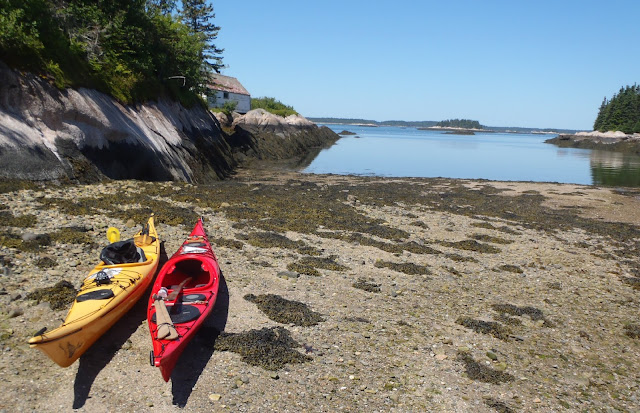
Glass like conditions inside (note Mark's boat is backward)
We stopped on a sandy bar between Knight and Mistake Islands for lunch. When we headed back along the western edge of the bay, I was reminded of another important lesson. My skeg no longer worked and I had to return to shore to work a rock out of the skeg box. Mark always drags his boat backwards along the shore to prevent that from happening.
Looking out toward Moose Point, the dark swell lines look pretty insignificant
Two black backs fight over a crab
One will be the victor!
I loved these little houses on tiny islands.
And yes, seals really do lie on their sides (again it is a blurry shot because we are keeping our distance.)
There were many fish pens marked on our charts. On the way out we hadn’t seen any, but this pen was still active off the Spectacle Islands.
We made it back to the ramp at about dead low. From my landing spot, I had some mud to tromp through before getting to solid ground. Mark paddled further onward, but still had a tough time landing on the rocky surface.
There were a few more cars in the lot, but not many, so I think paddling on a Sunday was a good idea. During our trip we only saw one seal pup. But the next time I paddle here I’ll probably wait until even later in the summer, to be sure the seal pups are fully grown.