
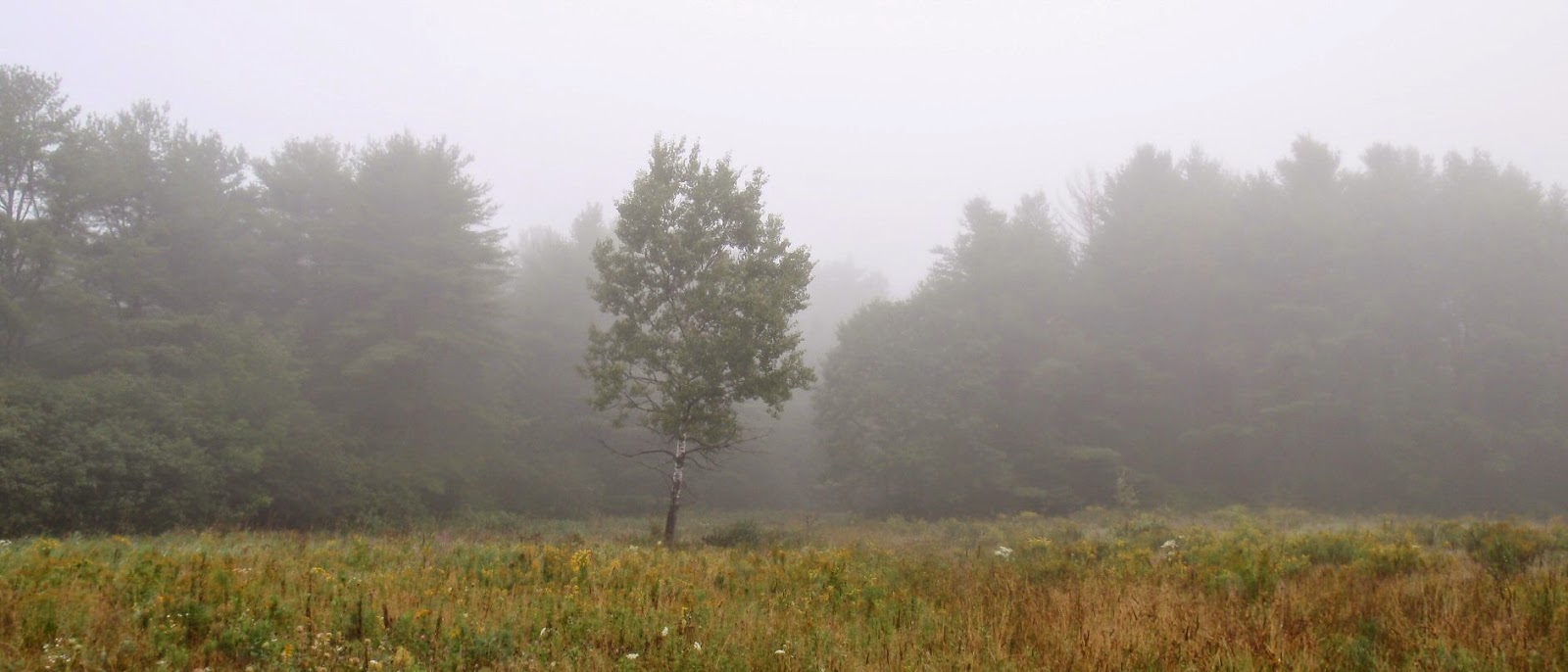
The Penobscot Bay Region had fallen to British control in the Revolutionary War. In August of 1779 the Bangor region had seen the tail end of the failure of the Penobscot Expedition, when a few American ships had tried, unsuccessfully, to escape by making their way up the river. The region had remained under partial British control/blockade through the end of the Revolutionary War.
In this new war, the War of 1812, one of Britain's goals was to shift the borders of the U.S., from the current St. Croix River to the Penobscot. In addition to giving the British access to the timber in the area it would even the southern line of British territory, so it was easier to move between Halifax Nova Scotia and Quebec City.
It had been raining through the night while militia gathered from the surrounding towns to serve under the command of General Blake of Brewer. Even as they arrived to defend the road, They were aware that the British had recently claimed Castine and Belfast, and many felt resistance was futile.
Meanwhile, three miles south at Bald Hill Cove, the 750 British soldiers who'd disembarked the night before began the march north. On the river the Britsh squadron set sail, continuing in their practice of firing shots to warn of the size of the advancing squadron.
It was between 7and 8 AM when the British Troops arrived at Pitcher Brook (now Reeds Brook) at the base of the hill where the militia was positioned. At the time, a narrow bridge crossed the stream, but Pitcher Brook is a small stream, and it's likely the British could have marched through it easily.
As the British came up on Pitcher Brook, the militia, led by Lt. Lewis, opened fire. Two British soldiers were killed, but the rest marched on.
 |
| Pitcher Brook passes under the road by the guard rail. Usually, the sharp dip creates more of a slow down than the stream flow. There is a building roof at wire height which is about where the militia set up. |
The militia on the hill made a rapid assessment of the approaching troops; the gleaming bayonets and uniforms appearing through the fog and mist. No doubt they could hear the blasts coming from the Penobscot River as well. Either in fear or rational judgement, the line broke. Men shed their arms and fled swiftly, in some cases swimming across the Souadabscook rather than waiting to cross the narrow bridge there.
North of the brief battle, by the pier, Capt Morris had seen the British squadron headed north. He began firing upon them, until signaled from his men on the ridge that the militia had fled. Realizing the hopelessness of his condition,, Captain Morris gave the command to spike the cannons remaining and sink the U.S.S. Adams. Captain Morris and his crew quickly departed the area and hiked a trail from Bangor to Canaan on the Kennebec River where they found transportation south.
 |
| Some Battle sites on Google Earth |
Many men were captured and held on the British prison ships overnight. However, the town as a whole survived. Windows were smashed, gardens ruined, livestock shoot and a bond demanded. No doubt 1815 became the long, hard winter the residents had feared. British maintained rule over the region until April 1815.
A few lighter tales from the Battle:

The Kinsley house, now owned by the Hampden Historical Society, was sought by Captain Barrie to use as his headquarters. He sent officers to her house to "request" it's use. As they approached the house, Mrs. Kinsley gathered the tools she had at hand, the slop buckets and chambers pots from the upstairs and, with the assistance of her maids, threw them out the window upon the officer. One officer was later heard to remark, that if the militia had been under Mrs. Kinsley's command, Hampden would be celebrating a victory.
The children of Hampden were gathered and led away to a house on Cold Brook for protection. However the housing there was decidedly inferior. Girls were bedded in the kitchen, boys in the hayloft, and meals consisted of nothing but cold potatoes. The next day the children were brought back to their parents, feeling their treatment at the hands of the British could be no worse.
Those are cute stories, but it must have been a very trying time. The records of the Massachusetts Volunteer Militia records this quote from the British Captain, Richard Barrie in response to a request for common safeguards of humanity, "I have none for you. My business is to burn, sink and destroy. Your town is taken by storm and by the rules of war, we ought both to lay your village in ashes and put its inhabitants to the sword. But I will spare your lives, though I don't mean to spare your homes."
(Maine was at the time still a part of Massachusetts.)
Hampden has never been very proud of the brief battle. In a direct quote from Historical Sketches of Hampden: "For years Hampden's militia bore the majority of the blame, since several officers and three militia companies raised in Hampden were present at the battle. A look at the records, however, will show that the militia companies of Bangor, Brewer, Dixmont, Eddington, and Orrington ran as quickly, as fast and as far as Hampden's."
And interestingly, this was not the end for the USS Adams:
 |
| On the Penobscot, by the mouth of the Souadabscook. The pier is about where the wharf would have been. |
 |
| Pretty much dead low looking south, the ship probably would have been somewhere in this area, depending on if hull work was still being done. |
The U.S.S. Adams remained on the bed of the Penobscot River for fifty-six years; its
copper sheathing quickly salvaged, but the rest undamaged. It’s hard to imagine that forty-six years of
ice freezing and thawing and high spring run-offs didn’t destroy the ship
completely, but in 1870 she was raised.
Her thick oak hull was relatively undamaged and sent to Boston for
repairs. She would spend another 40
years as a Navy sailing trainer ship, sailing all over the world before being
retired in 1920.

Sources: A Call to Arms Celebrations Re-enactment of Battle at Hampden August 22,23,24 1980
Historical Sketches, Hampden Maine 1767-1976 Hampden Historical Society 1976.
Battle of Hampden, USS Adams 1799 Wikipedia
Sprague's Journal of Maine History 1914
Historic Shipwrecks of Penobscot Bay, Harry Gratwick History Press 2014
Maine Gravestones and Flags; Honoring our Heroes. Emeric W. Spooner, 2010

